Keynote: Wesleyan Vile-tality: Reclaiming the Heart of Methodist Identity
By Dr. Ashley Boggan, General Secretary of the General Commission on Archives and History.
Link to video of keynote
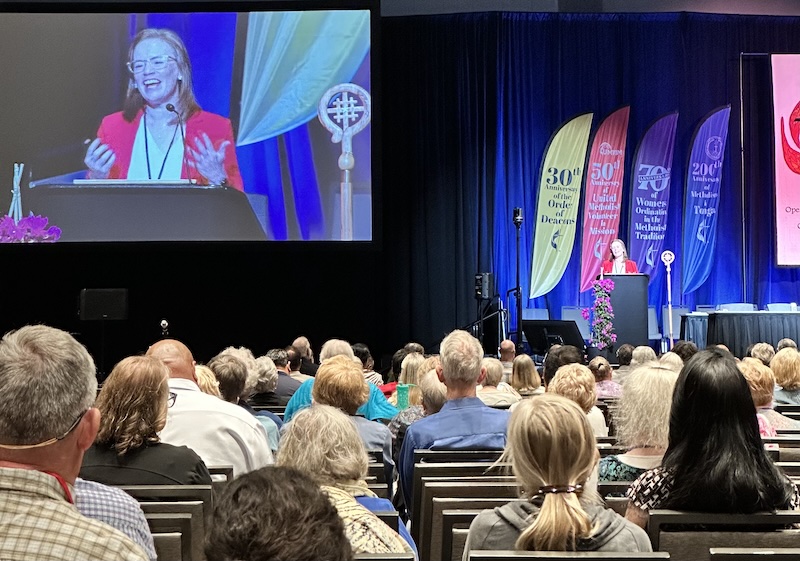
Dr. Boggan reminded us of John Wesley’s going to where the people in need were outside of the church walls tending to their physical and spiritual needs. He got into trouble with the church authorities because he preached “in the field” rather than requiring the people to come to church to hear the gospel (sort of reminds me of that other guy we talk a lot about who lived 2000 years ago). Below are slides from her keynote.
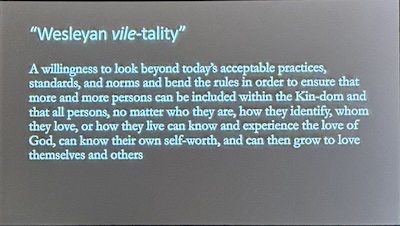 -
- 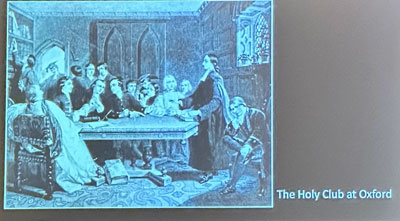
Wesley’s ministry to the marginalized outside of the church walls was called “vile” by the proper folk of his day and he embraced the word. The “Holy Club” at Oxford was John Wesley (actually not an Oxford student but a fellow at Lincoln College) , Charles Wesley (actually a student at Christ College), William Morgan, John Clayton, George Whitefield, and perhaps one other Oxford student. During his college years, John Wesley was trying to discern what was his “extraordinary call” that he felt since the age of 5 when he was saved from the fire at the Epworth parish. The Holy Club took religion seriously—working on their faith every day, multiple times in the day; faith as love acted out. It was the expectation of Wesley’s day that only proper people attended church on Sunday to sing a few hymns and hear a pleasant sermon and then leave with nothing asked of them when they left the building. The Holy Club group began leaving the walls of Oxford to where the poor, the outcast were and the imprisoned.
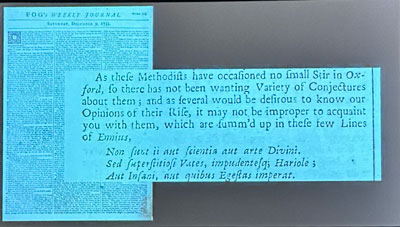
Morgan urged that the Holy Club group should minister to those in the two nearby prisons, the Bocardo and the Castle, asking them what their spirits and bodies needed. They brought food, water, reading materials, worship services, and one-on-one times where they talked about each other’s souls—mutual respect and love, restoring their humanity. Thomas Blair was on death row for alleged homosexuality and was persecuted by his fellow inmates and the guards. John Wesley and John Clayton used their college education to advocate on Blair’s behalf at his trial. Blair’s life was spared and he was fined the equivalent of about $7000. John Wesley used his connections to raise the money to get Blair released. This story of Blair and Wesley is foundational to our name “Methodist”. First use of the word Methodist:
 -
-
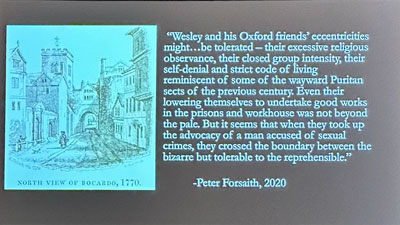
Weekly newspaper at Oxford, “the Fog Weekly Journal”, December 9, 1732 article about the Holy Club’s “bizarre” prison ministry: “as these Methodists have occasioned no small stir in
Oxford, so there has not been wanting variety of conjectures about them and as several would be desirous to
know our opinions of their rise, it may not be improper to acquaint you with them, which are summed up in these
few lines of Ennius, “Non enim sunt ii aut scientia aut arte divini, sed superstitiosi
vates inpudentesque harioli, [aut inertes] aut insani aut quibus egestas imperat."
Translation:
"For they are not divine either in knowledge or in art, but rather superstitious seers and shameless prophets, either lazy or insane, or driven by poverty.”
John Wesley wrote more about Thomas Blair in his Oxford diaries than any other inmate he ministered to. Peter Forsaith is the one who uncovered this first use of the word Methodist in 2010s (article published in 2020). See right slide above. People could tolerate the Holy Club’s intense private piety and prison ministry but when they took up Blair’s case, that crossed a boundary of acceptability. “Methodist” describes John Wesley and this peculiar method of loving all.
 -
-
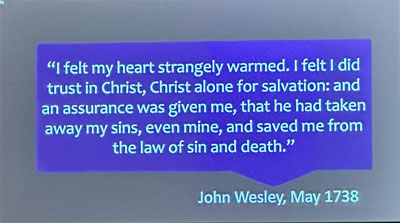
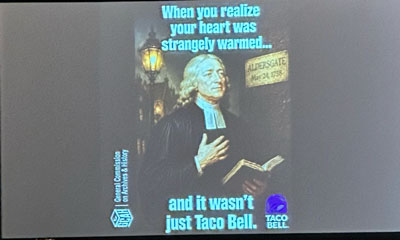
After Oxford, John Wesley still struggled to understand how to live into his “extraordinary call”. May 24, 1738: Wesley’s heart was “strangely warmed”; he finally realized that God loves him but what did he do with that? Wesley told the Aldersgate society where he had the heart-warming experience. One of of the society members asked Wesley, “If you have faith, where is your joy?”John entered a time of spiritual crisis for over a year trying to answer that.
 -
-
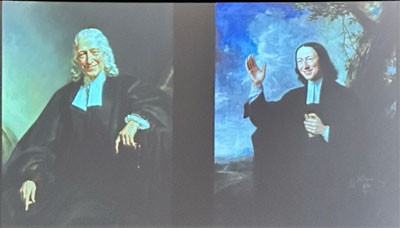
(Left slide): No artwork we have depicting John Wesley shows him smiling, so Boggan asked ChatGPT to generate a couple of images of Wesley smiling.
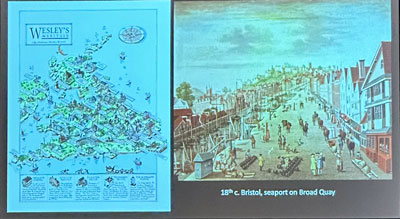
(Right slide): In 1738 at a reunion of the Holy Clubbers, the members make a pact to create a spiritual renewal
within the Church of England, to take what they learned at Oxford out into the community. George Whitefield had
been in Bristol preaching in January-March 1789. Bristol was the main seaport for the Atlantic slave trade and
the birthplace of the Industrial Revolution. Lots of manufacturing and surrounded by coal mines. Built for 5000
people, Bristol had 40,000 people within its bounds (with no modern sanitation/sewage), so Bristol was known as
the dirtiest town in the Western World. After reaching out to Charles Wesley and three others to relieve him,
Whitefield reached out to John Wesley. Wesley found out upon arriving at Bristol that Whitefield had been
preaching out in the coal mines, in the fields.
 -
-
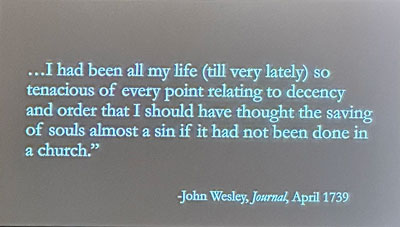
(Left slide): Wesley wrote in his journal April 1739: “I scarcely could reconcile myself at first to the
strange of preaching in the fields. For I had been all my life (till very lately) so tenacious of every point
relating to decency and order that I should have thought the saving of souls almost a sin if it had not been
done inside the walls of a church.” Wesley saw that the coal miners had been transformed when they heard
that they too were worthy of God’s love.
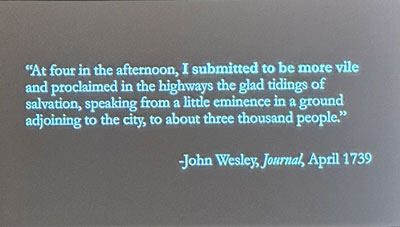
(Right slide): April 2, 1739 wrote: “At four in the afternoon, I submitted to be more vile
and proclaimed in the highways the glad tidings of salvation, speaking from a little eminence in a ground
adjoining to the city, to about three thousand people.” Uses “submitted”: Wesley did not want
to do this. Wesley knew that preaching in the mines & fields would get him in trouble with the church
authorities. Uses “vile”: Wesley really did not want to do the preaching outside of the church
building but God called him out to the fields (a vile, disgusting, unseemly place) and to break the rules of
the institution of preaching and proper church practice. Wesley had submitted himself to the leading of the
Holy Spirit to take the message of God’s love to people who needed it most. Worthington (historian)
notes: “while John Wesley’s heart was strangely warmed in London, it was set afire in
Bristol.”
 -
-
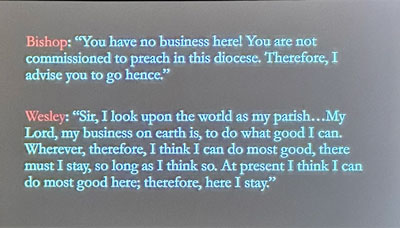
(Left slide): After three days of Wesley being in Bristol, the Bishop writes to Wesley “You have no
business here! You are not commissioned to preach in this diocese. Therefore, I advise you to go hence.”
Wesley responds writing back to the Bishop: “Sir, I look upon the world as my parish. My Lord, my
business on earth is, to do what good I can. Wherever, therefore, I think I can do most good, there must I
stay, so long as I think so. At present I think I can do most good here; therefore, here I stay.”
God’s love cannot be confined to human-made space. Holy Spirit both comforts us and pulls us to places
that are uncomfortable.
(Right slide): The fellow Holy Clubbers expressed concern to John Wesley and Whitefield about preaching outside of
the church walls. They wanted the Church of England to like them so that they could create the renewal inside
the church. John Clayton wrote: “How is it that one does good when others are saying that your actions
are evil?” How is being vile the doing of God’s will? How is being the scourge of society is
showing the love of God; following God’s will? John Wesley’s answer is in his journal in June 1739:
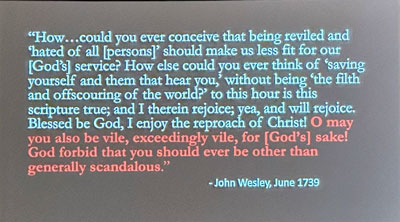
“How could you ever conceive that being reviled and ‘hated of all [persons]’ should make us
less fit for our [God’s] service? How else could you ever think of ‘saving yourself and them that
hear you’, without being ‘the filth and offscouring of the world?’ To this hour is this
scripture true; and I therein rejoice; yea, and will rejoice. Blessed be God, I enjoy the reproach of Christ! O
may you also be vile, exceedingly vile, for [God’s] sake! God forbid that you should ever be other than
generally scandalous."
Such a good quote needs to be on a T-shirt or mug—get it from the QR code.
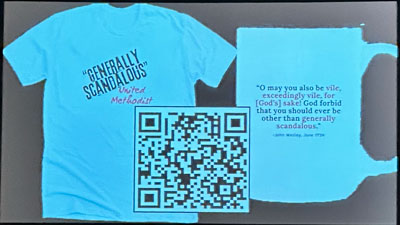
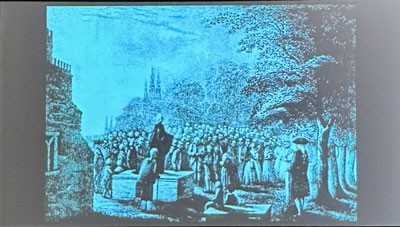
John Wesley calls us to be generally scandalous with him. Our focus should be to take God’s love outside of the church walls to those who need it most. After several years, preaching "in the fields” becomes a characteristic of the early Methodists.
 -
-
(Left slide): In 1742 Wesley
returns to his home parish at St Andrews Parish in Epworth, where his father preached for 20 years and all the
8 Wesley children were baptized and confirmed. Wesley asked the pastor if he could be of assistance. The
pastor said “No thank you. In fact, I would like it very much if you would leave the premises or else I
will have you removed.” However, the town folk want to hear what Wesley has to say. Wesley finds a way to
preach while respecting the wishes of the pastor by preaching from his father’s gravesite—a place
owned by the Wesley family; bending but not breaking the rules. Early Methodists continually found ways to
circumvent rules in order to take God’s love to where it was needed most.
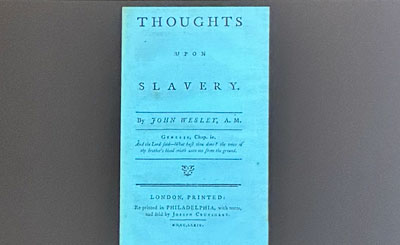
(Right slide): John Wesley also wrote/published against slavery. Wesley was reminded about the institution of
slavery every time he went back to Bristol. “Thoughts Upon Slavery” in 1774 is his conversation
with another abolitionist blaming social & racial hierarchies on rich white persons who enslaved others.
Generational trauma that will happen because of the maltreatment and harm done by institution of slavery.
Wesley called on Methodists to end slavery. On his deathbed, Wesley wrote to William Wilburforce, asking him to
carry on the Methodist witness against slavery.
Wesley had been against slavery as far back as 1735 in his Georgia days. Another story told has Wesley in Georgia denying a woman he loved communion because she married another man, so the popular rendering is that Wesley denied her communion because she broke his heart. What actually happened is that Wesley denied her communion because of who she married: an enslaver. By doing so, she became an enslaver through marriage and thereby broke the Methodist rules and was doing harm by enslaving others. Wesley was going to be arrested in Georgia because of his denial of communion to the woman but Wesley escaped Georgia and sailed back to London.
Several years later, Wesley let lay people preach beginning with lay male preachers. Thomas Maxfield was the first lay preacher. Maxfield started preaching in the foundry in 1740. Wesley initially was going to stop Maxfield from preaching but his mother, Susanna Wesley, stopped John and told him to listen to Maxfield first before passing judgement. Wesley realized that Maxfield also had an “extraordinary call” of the Holy Spirit. By 1755, Wesley let lay women preach as well—Wesley had discerned that the Spirit of God falls equally upon us all.
 -
-
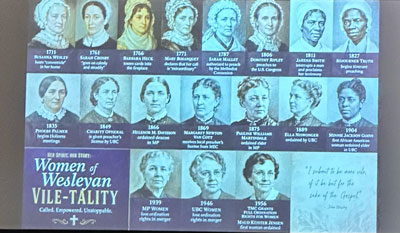
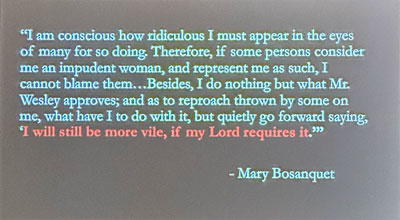
(Left slide): Two women in particular showed Wesley that lay women are also called: Sarah Crosby and Mary
Bosanquet—on right slide they are the 2nd and 5th women from the left in the top row. Crosby and
Bosanquet established the community center called Cross Hall, providing housing for widows and orphans,
kindergarten and day care, food & hygiene products, and vocational training regardless of social standing.
Many people (women AND men) came to hear Crosby and Bosanquet speak. Crosby apologized to Wesley for speaking
in public in 1760 but Wesley responded: “Go on calmly and steadily. You have done nothing wrong.”
In 1770 Bosanquet wrote the premier theological treatise of women preaching. She was often asked why she felt
she had the audacity to preach. She would respond, “I am conscious how ridiculous I must appear in the
eyes of many for do doing. Therefore, if some persons consider me an impudent woman, and represent me as such,
I cannot blame them. Beside, I do nothing but what Mr. Wesley approves; and as to reproach thrown by some on
me, what have I do do with it, but quietly go forward saying “I will still be more vile, if my Lord
requires it.”
(Right slide): In honor of the 70th Anniversary of Clergy Women in full connection, let’s remember that long
history of Methodist women from Susanna Wesley (top row, far left 1711) to Maude Keister Jensen (bottom row,
far right 1956). They saw the “vile-tality” as a holy willingness to cross boundaries for the sake
of the gospel and the transformation of the world. All of these Methodist women (and others), their ministries
show that Wesleyan vile-tality is not fringe behavior detached from Methodist identity. It is one of the
animating engines of Methodist history: holiness is not passive piety but grace enacted boldly in this world.
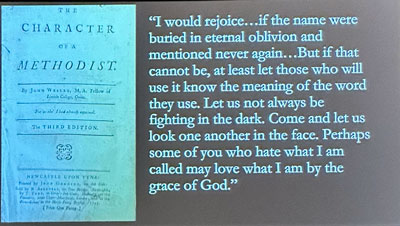
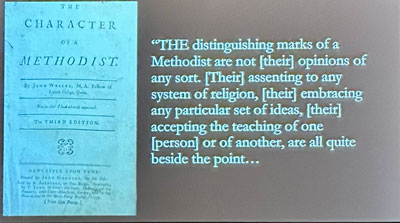
In 1742, John Wesley wrote a treatise called “The Character of a Methodist”. Next several slides below. What it meant to be a Methodist back then and what it means to be a United Methodist today in 2026.
 -
-
(Left slide): John Wesley hated the name “Methodist”, preferring “United Societies” but
“Methodist” stuck, so he began his treatise with: “I would rejoice if the name Methodist were
buried in eternal oblivion and mentioned never again. But if that cannot be, at least let those who will use it
know the meaning of the word they use. Let us not always be fighting in the dark. Come and let look one another
in the face. Perhaps some of you who hate what I am called, may love what I am by the grace of God.”
(Right slide): Typical British way of defining something by stating what it is NOT. Wesley stated, “THE
distinguishing marks of a Methodist are not their opinions of any sort; [their assenting to any system of
religion; [their] embracing any particular set of ideas; [their] accepting the teaching of one [person] or of
another, are all quite beside the point.”
 -
-
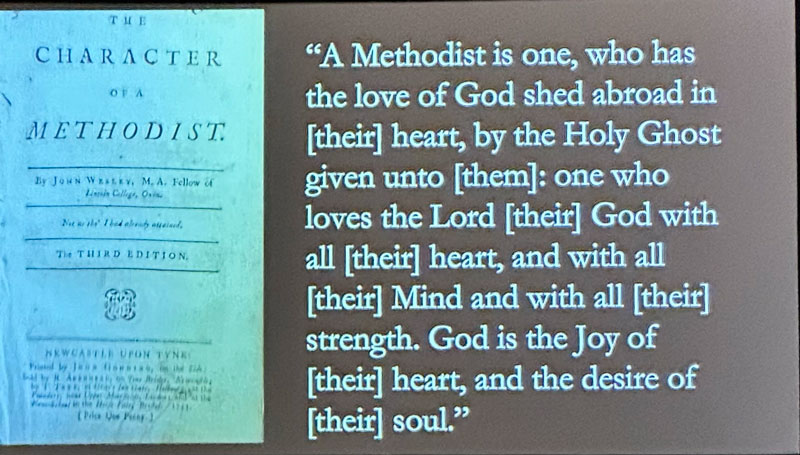
(Left slide): So what are Methodists known for? “A Methodist is one, who has the love of God shed abroad
in [their] heart, by the Holy Ghost given unto [them]: one who loves the Lord [their] God with all [their]
heart, and with all [their] Mind and with all [their] strength. God is the Joy of [their] heart, and the desire
of [their] soul. (Deuteronomy 6:5, Matthew 22:37, Mark 12:30). John finally found his joy when he submitted to
the Holy Spirit and preached in the fields. Other early Methodists shared the same joy.
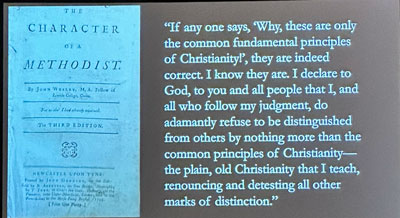
(Right slide): Wesley could be a bit snarky: “If any one says, ‘Why, these are the only the common
fundamental principles of Christianity!’ They are indeed correct. I know they are. I declare to God, to
you and all people that I, and all who follow my judgment, do adamantly refuse to be distinguished from others
by nothing more than the common principles of Christianity—they plain, old Christianity that I teach,
renouncing and detesting all other marks of distinction.” Wesley is proving to the Church of England that
Methodists are indeed Christian.
 -
-
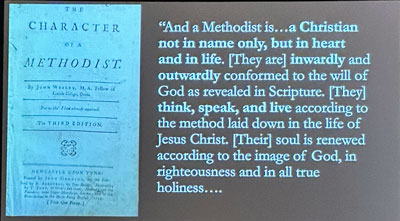
(Left slide): Wesley takes a dig at the Church of England though: “And a Methodist is a
Christian not in name only but in heart and in life. [They are]
inwardly and outwardly conformed to the will of God as revealed in
Scripture. [They] think, speak, and live according to the method laid down in the life of
Jesus Christ. [Their] soul is renewed according to the image of God, in righteousness and in all true
holiness.”
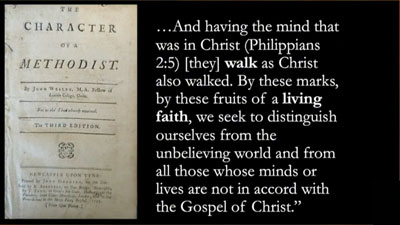
(Right slide): “And having the mind that was in Christ (Philippians 2:5) [they] walk as
Christ also walked. By these marks, by these fruits of a living faith, we see to
distinguish ourselves from the unbelieving world and from all those whose minds or live are not in accord
with the Gospel of Christ.” So above all else, Methodists are persons who act. In light of
what’s happening in 2026, we need good theology today! A theology rooted in the grace and love of God
now more than ever. Also need new forms of connection, community, and watching over one another in love. Be
vile for God’s sake. Institutional survival alone is not a compelling mission. Obsessing over
denominational decline is what Wesley feared most.
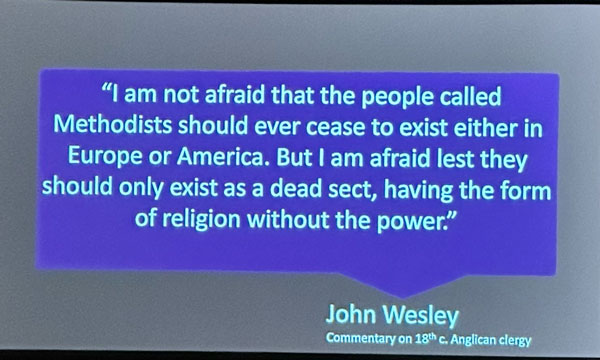
Wesley did not find joy sitting safely inside systems that already worked for him. He found joy when he followed the Holy Spirit into the fields that he was never supposed to enter. May it be so for us United Methodists as well.